You can buy something croissant-shaped for a dollar. You can also pay six times that for one, and the difference is not branding. It is a process that takes days and cannot be shortened.
Worth understanding, because once you know what to look for you can tell them apart from across a counter.
Lamination, plainly
A croissant is not a bread recipe. It is a structure.
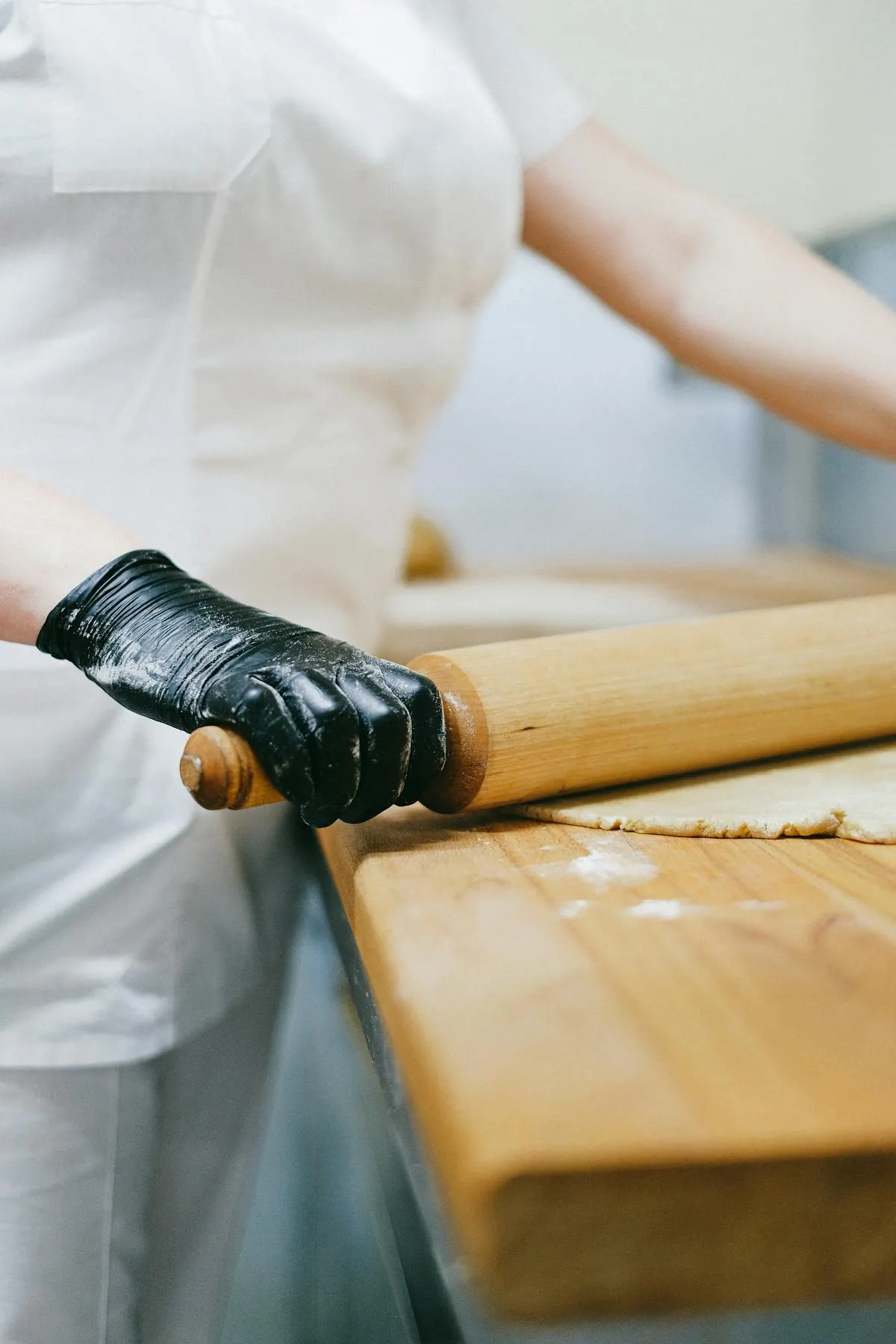
You make a yeasted dough. You take a slab of butter and enclose it in that dough. Then you roll the whole thing out and fold it, and roll and fold again, and again, resting it cold in between every time.
Each fold multiplies the layers. Three folds of three produces twenty-seven alternating layers of dough and butter. Those layers are the entire point.
In the oven, the water in the butter turns to steam. Steam expands, pushing the dough layers apart, and the dough sets in that pushed-apart position. The honeycomb you see when you tear one open is a record of that. Those holes were steam.
That is lamination. Everything else is detail.
Why it takes three days
Butter is the problem, and the whole craft is managing it.
Too warm and the butter melts into the dough. The layers merge, the steam has nowhere to go, and you get a dense bread roll that happens to be curved. Too cold and the butter shatters into pieces instead of rolling out in a continuous sheet, which tears the layers.
The working window is narrow. Which means the dough goes back into refrigeration between every fold, and each rest takes hours. You cannot do it faster by working harder.
Then the shaped croissants proof, slowly, at a temperature warm enough for the yeast and cool enough for the butter. That is its own several hours, and it cannot be rushed either. A croissant proofed too warm leaks butter into the pan and bakes flat and greasy.
Three days is not craftsmanship theater. It is the schedule the material dictates.
Butter, and what replaces it
Commercial production commonly uses a laminating margarine instead of butter. It is not a scandal, it is an engineering decision, and it makes sense from the manufacturer’s side: margarine is formulated with a much wider plastic range, so it stays rollable across temperatures where butter would either melt or crack.
That makes the process forgiving enough to run on a machine, at speed, without a three-day schedule.
The cost is in the mouth. Butter melts near body temperature, which is why a butter croissant seems to disappear as you eat it. Margarine has a higher melting point, so it does not fully melt in your mouth, and it leaves a coating on the palate. Once you have noticed it you cannot stop noticing it.
French bakers use beurre de tourage, a butter with lower moisture and better working properties than table butter. Still butter. Just butter selected for the job.
How to tell, from the outside
Look at the layers on the cut end. A laminated croissant shows distinct visible sheets. A shaped, unlaminated one looks like bread inside.
Pick it up. A real croissant is startlingly light for its size. If it feels substantial, the layers collapsed.
Tear it, do not cut it. It should pull apart into strands and shed flakes. If it tears like a dinner roll, that is what it is.
Smell it. Butter is unmistakable and margarine is close to odorless.
Look at the base. A well-baked croissant is deeply browned underneath, not pale. Pale bottoms mean it came out early.
Watch the color. A proper croissant is dark. Almost alarmingly so to an American eye. That is where the flavor is, and a uniformly pale golden croissant has been baked to look nice rather than to taste like anything.
Why they are best the day they are baked
A croissant is at its peak for a few hours. Not because of preservatives or the lack of them, but because of physics.
Those layers are held apart by a crisp, dry structure. The moment it comes out of the oven, moisture starts migrating from the humid interior outward into that crisp shell. By the next morning the outside has softened and the shattering quality is gone. The flavor is still there. The texture, which is most of what you were paying for, is not.
Reheating recovers some of it. A few minutes in a hot oven, never a microwave, drives moisture back out of the crust. A microwave does the opposite and turns a croissant into something chewy and sad.
This is also why a bakery with croissants stacked high at four in the afternoon is telling you something. Either they baked far too many, or they did not bake them today.
Why the price is the price
A croissant made this way is three days of scheduled work, real butter at real butter prices, refrigeration space held the whole time, and a person who knows how to read the dough. It does not scale by adding a machine.
That is the entire cost structure. There is no margin trick in it.
What we make
Ours are laminated by hand, with butter, on the schedule the dough requires. Which means we do not have a hundred sitting out on a Tuesday. It also means the ones we do have were made this way and not another way.
If you are planning an event and want laminated pastries as part of it, that timing matters for the order too. Get in touch and we will work out what is realistic for your date.