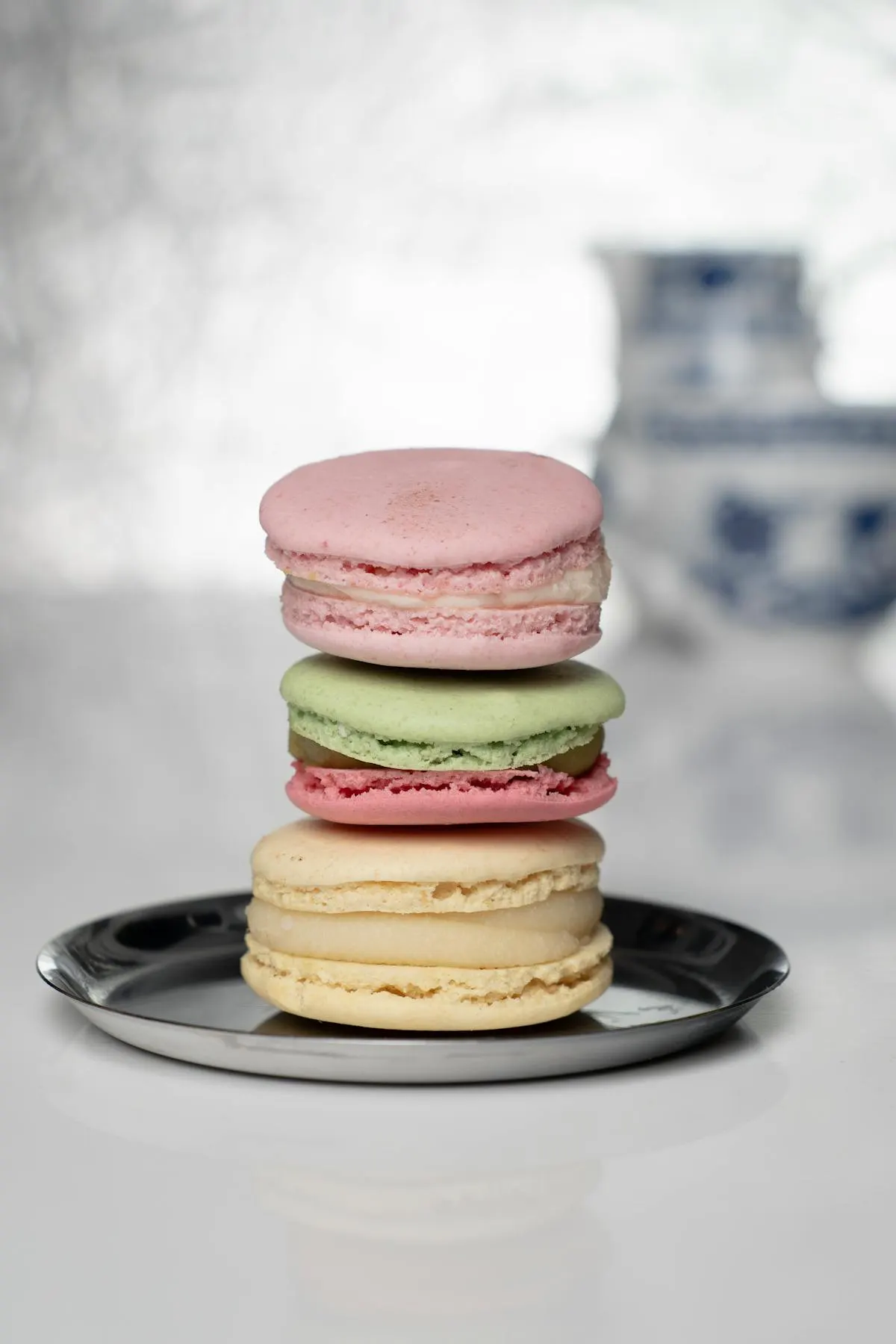
The classic French macaron is naturally wheat-free. The shells are built from almond flour, powdered sugar, and egg whites: no wheat, no rye, no barley, no oats. The filling is most often a buttercream, ganache, or fruit jam, none of which require gluten either. So the recipe itself contains no gluten.
That single sentence is where most “are macarons gluten-free” search results stop. It’s also where the answer gets honest people in trouble. Naturally wheat-free is not the same as safe-for-celiac, and a French bakery that takes the question seriously will tell you so without flinching.
This piece is the longer version: what’s in a macaron, where gluten can sneak in, and how to ask a bakery the right question if you have a real allergy versus a preference.
What’s in a real French macaron
A French macaron (the little sandwich-shaped almond cookie with the smooth dome and the small ruffled “foot” at the base) has exactly three things in the shell:
- Almond flour (poudre d’amandes). Sometimes labeled almond meal in the United States. Finely ground blanched almonds. Naturally gluten-free; the United States Department of Agriculture lists tree nuts and tree-nut flours as gluten-free foods (see USDA’s Healthy Eating on a Gluten-Free Diet).
- Powdered sugar (sucre glace). Cane or beet sugar ground to a powder. Pure cane and beet sugar are gluten-free, but commercial powdered sugar usually contains 2–3% cornstarch as an anti-caking agent. Cornstarch itself is gluten-free; the catch is that some brands use a wheat-derived starch instead. A serious pâtissier reads the label.
- Egg whites (blancs d’œufs). Aged in some bakeries (left out at room temperature for 24–48 hours to dry slightly, which produces a more stable meringue). No gluten anywhere.
Fillings vary. The four most common (French buttercream, Italian buttercream, ganache, and fruit jam) are all gluten-free in their classical recipe. A salted caramel filling is also gluten-free if the caramel is built from sugar, cream, and butter rather than from a commercial paste with stabilizers.
The shell recipe has been documented this way since the early twentieth century, when Pâtisserie Ladurée in Paris formalized the modern macaron Parisien: two shells with a filling sandwiched between. There has never been a traditional version that uses wheat flour. If you find a “macaron” recipe online that calls for all-purpose flour, it isn’t a French macaron. It’s an American adaptation that borrows the name.
Where gluten sneaks in anyway
If the recipe has no gluten, why aren’t all macarons safe for celiac diners? Three reasons. A bakery that handles your allergy seriously knows all three.
1 · Cross-contact in the kitchen. A typical French patisserie kitchen also makes croissants, brioche, pâte feuilletée, tartes, and cake layers — every one of which contains wheat flour. Flour is microscopic and airborne; it settles on every surface, drifts into mixers, sticks inside oven cavities. A macaron baked next to a brioche may pick up enough flour dust to trigger a celiac reaction even if no flour ever entered its batter. The recipe is gluten-free; the kitchen is not.
2 · Powdered-sugar starch. Commercial powdered sugar in the United States contains an anti-caking starch: usually corn, occasionally wheat. Most major brands (Domino, C&H) use cornstarch and label accordingly, but bulk food-service powdered sugar can vary. A pâtissier baking for a celiac order checks the bag.
3 · Filling shortcuts. The classical fillings are clean. The shortcuts are not. A pre-made commercial fondant filling, a cookie-crumble decoration, or a rim of crushed Speculoos cookies on a salted-caramel macaron can each carry gluten into a sandwich whose shells are otherwise fine. Ask before you eat.
”Gluten-free” versus “celiac-safe”: the distinction that matters
The U.S. Food and Drug Administration’s labeling rule defines a “gluten-free” claim as fewer than 20 parts per million (ppm) of gluten in the finished food. That threshold was set in 2013 and is the threshold most diagnosed celiac patients can tolerate without an immune reaction.
A bakery is permitted to label something gluten-free only if it can stand behind that 20 ppm number. Most small French bakeries, including ours, don’t test to that threshold and won’t use the label. The honest language goes something like:
- “No-wheat” or “wheat-free.” True. The recipe contains no wheat.
- “Made without gluten ingredients.” True, and a useful intermediate phrase. Means: every ingredient on the recipe is gluten-free, but we cannot promise the kitchen environment.
- “Celiac-safe” or “gluten-free certified.” A higher bar. Requires a dedicated, segregated kitchen or a certified gluten-free production line. Most artisan French bakeries cannot honestly use this language.
If you have celiac disease or serious non-celiac gluten sensitivity, you want the third tier, and you will rarely find it at a small French patisserie that also bakes croissants. Look for a dedicated gluten-free bakery (there are a few in greater Houston) or a French bakery that runs a separate gluten-free morning bake with full kitchen reset. Both exist. Neither is the norm.
If your concern is dietary preference rather than diagnosed allergy, a macaron from a careful patisserie is well within tolerance, and is the dessert most often listed first on a planner’s gluten-friendly options because the recipe itself is so clean.
How we handle the question
When a wedding planner, private host, or corporate client asks us “are these gluten-free,” the honest answer is the long version above, not a yes or no. This is the language we actually use:
“Our macarons are made with almond flour, powdered sugar, and egg whites — no wheat in the recipe. They are not certified gluten-free. For a guest with a dietary preference for gluten-free desserts, our macarons are the safest pick on our menu. For a guest with diagnosed celiac disease, we recommend you contact us directly so we can talk through a separate batch protocol — or we can refer you to a Houston bakery that produces in a fully segregated gluten-free environment.”
No claims we can’t stand behind, no shrugged-off allergy, and a clear path forward for either kind of customer.
For larger events where one or two guests have celiac disease, the practical solution is almost always a separate small batch baked first thing in the morning before any wheat flour is opened: equipment wiped down, parchment changed, fresh apron on. Any pâtissier with kitchen experience has done this and will quote it as a line item on top of the regular order. It is not a luxury upcharge; it is the cost of running a kitchen reset, and it is worth asking about early rather than the week of the event.
Other “is it gluten-free” pastries worth knowing about
Since we get the question often, a quick reference:
- Madeleines: not gluten-free. Wheat flour is the structure of the shell-shaped cake.
- Tartelettes: crust is wheat-based. The pâte sablée is butter, sugar, egg, and all-purpose flour. Fillings are usually gluten-free; the shell isn’t.
- Crème brûlée: naturally gluten-free (egg yolks, cream, sugar, vanilla). A reliable pick at almost any French restaurant.
- Pots de crème, mousse au chocolat: naturally gluten-free. Same cross-contact caveats apply.
- Croquembouche: not gluten-free. The cream-puff shells are choux pastry: wheat flour, water, butter, and eggs.
- Forêt-Noire, Fraisier: not gluten-free in classical form. Both rest on a wheat-based génoise sponge.
If you’re planning a wedding or private event with a guest who has a serious gluten requirement, the workhorse of a gluten-friendly French dessert table is the classical macaron with classical fillings, supported by chocolate mousse cups and fruit-tart filling served in small glass jars without the crust. The combination eats like a real French dessert spread without any obvious “gluten-free menu” feel.
Frequently asked questions
Are French macarons gluten-free? The classical recipe is naturally gluten-free: almond flour, powdered sugar, and egg whites contain no wheat, rye, barley, or oats. Whether a specific batch is safe for someone with celiac disease depends on the bakery’s kitchen environment. A patisserie that also bakes croissants and cakes shares wheat flour in the air and on surfaces, which means cross-contact is possible even when the macaron recipe itself contains no gluten.
Why do some “gluten-free macarons” still cause a reaction in celiac diners? Almost always because of cross-contact. The recipe is clean, but in a shared kitchen, airborne flour can settle on shells before they’re filled and packaged. The 20 ppm FDA threshold is hard to meet that way. If a reaction happens, the most likely cause is environmental, not a hidden ingredient.
Are the fillings gluten-free? The classical fillings (French buttercream, Italian buttercream, ganache, fruit jam, lemon curd, salted caramel) are all gluten-free in their traditional recipe. Watch out for shortcut versions that include cookie crumbs (Speculoos, biscoff, graham), pre-made commercial fondant, or “cookie butter” spreads, all of which are wheat-based. Ask the bakery what’s inside before you buy.
Can a celiac diner safely eat macarons? Sometimes, with the right bakery. A dedicated gluten-free bakery, or a patisserie willing to bake a segregated batch with a clean equipment reset, can produce celiac-safe macarons. A general-purpose French bakery sharing a kitchen with wheat-based pastries usually cannot, even with the best intentions. The honest question to ask a bakery is: “Do you bake macarons in a fully segregated environment, or share a kitchen with wheat?” If they share, ask whether they offer a separate-batch protocol for celiac orders.
What makes a macaron different from a coconut macaroon? Different cookies, despite the similar names. A French macaron (one-o) is the smooth-domed almond-flour sandwich cookie. An American or British macaroon (two-o’s) is a chunkier coconut-and-egg-white cookie, often dipped in chocolate. Macaroons are usually gluten-free as well (coconut, egg whites, and sugar) but always check, because some recipes add wheat flour or sweetened condensed milk with stabilizers.
Do you make gluten-free macarons in Magnolia or The Woodlands? We bake every macaron from almond flour, powdered sugar, and aged egg whites: no wheat in the recipe. Our kitchen also bakes wheat-based pastries, so we cannot label our macarons gluten-free in the FDA sense. For a wedding or private event with a guest who has celiac disease, contact us. We can talk through a separate-batch protocol or refer you to a Houston bakery operating in a fully segregated gluten-free environment.