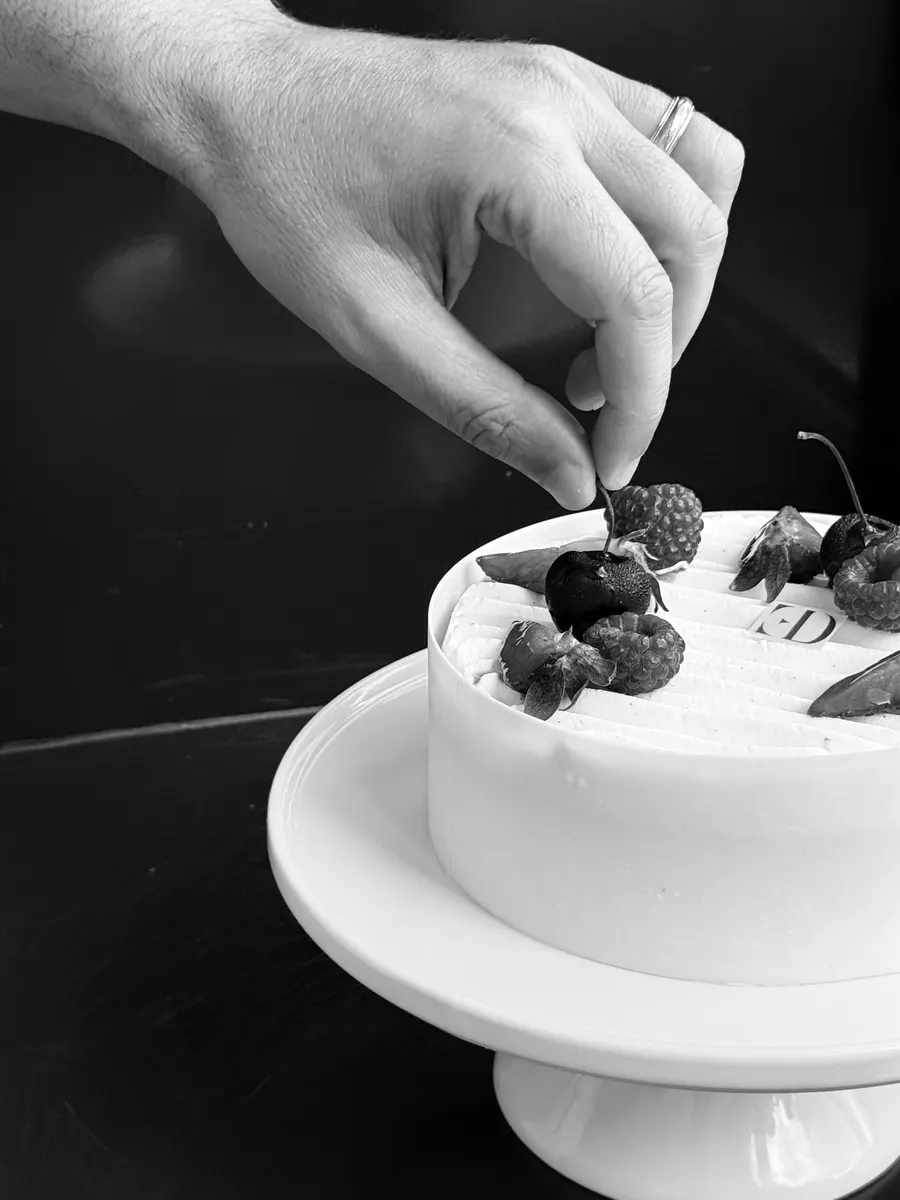
People see the word on the menu, under Gâteaux & Entremets, and ask what the second half means. Fair question. It’s one of those French words that gets used as if everyone knows it.
An entremet is a layered French dessert built inside a ring or a mold, set cold, turned out, and finished with a glaze or a fine coating. The body of it is usually a mousse. Inside the mousse sits an insert, which is a thinner layer of something with a different texture and a sharper flavor: a fruit compote, a crémeux, a caramel. Underneath is a thin base that gives you something to bite against. It is served cold, in clean slices, and every slice shows the same cross-section.
That’s the short answer. The rest of this is why it is built that way and what it means when you order one.
Where the word comes from
Entremets, in the old French sense, were the dishes served between courses at a long banquet. Between the roast and whatever came next, something arrived to reset the table. Over a few centuries the word narrowed until it meant the sweet course, and then narrowed again in pastry kitchens until it meant this specific thing: a composed, cold-set, multi-layer cake.
So when a pastry chef says entremet, they do not mean “dessert” in general. They mean a construction.
The layers, from the bottom up
The base. A thin disc of something with crunch or chew. A sablé, a dacquoise, a layer of praliné with feuilletine folded in. It is there for contrast. Without it, the whole slice is soft on soft and the palate gets bored halfway through.
The insert. This is the part most people don’t know is there until they cut it. A layer of fruit compote, a passion fruit crémeux, a salted caramel, a jelly. It’s small on purpose. It carries the sharp, bright, or bitter note that keeps the mousse from being simply sweet.
The mousse. The volume of the cake. Chocolate, vanilla, a fruit, a nut. A mousse is lighter than a buttercream and holds far less sugar, which is why a slice of entremet reads as lighter than a slice of frosted layer cake of the same size.
The finish. A mirror glaze poured over the cold cake so it sets glassy, or a velvet spray that leaves a matte, suede-like surface. Either one is the last step, and either one only works because the cake underneath is cold and firm.
Because it is built inside a mold, an entremet is usually assembled in reverse. The mousse goes in first, the insert is pressed into it, the base goes on top, and the whole thing is turned over when it comes out. That’s how the top ends up perfectly flat and the sides perfectly straight, which no amount of spreading frosting with a spatula can match.
How it differs from a layer cake
A layer cake is sponge, filling, sponge, filling, frosted on the outside. It is built at room temperature and eaten at room temperature, and the sponge does most of the work.
An entremet is mostly mousse, with very little sponge or none at all. It is built cold and served cold. The texture is closer to a very good ice cream cake than to a birthday cake, though nothing in it is frozen when it reaches you. It is also less sweet per bite, because mousse and fruit do not need the sugar that a buttercream does to hold its shape.
The two are not competing. A fraisier, which is on our menu, is a gâteau: génoise sponge, crème mousseline, a wall of fresh strawberries. It’s a different animal from an entremet and it’s meant to be. Both live under the same heading on the menu because both are whole cakes made to order.
What a slice tells you
Cut an entremet and look at the cross-section. The layers should be level and distinct, the insert centered, the base thin enough that it does not fight the fork. The glaze should be a skin, not a shell.
That cross-section is why entremets photograph the way they do, and why they suit a seated dinner where dessert arrives plated. Everyone at the table gets the same slice, and every slice looks like the one on the menu.
Where it fits, and where it does not
For a seated wedding dinner, individually plated entremets are one of the ways we handle the dessert course. Each guest gets a small, complete cake with its own layers, and the caterer sends them out with the coffee.
For a dessert table, entremets have limits. They are cold-set. Left out on a table for three hours in a warm room they lose their edges, and in a Houston summer outdoors they lose them faster. I wrote about what holds up in the heat and what does not, and a mirror-glazed entremet is firmly in the second group. For an outdoor event, smaller pieces that come out in waves from a cooler are the better plan.
For a whole cake at home, an entremet is a fine choice for a birthday or an anniversary if you like the idea of something lighter than frosting. It needs a fridge until shortly before it is served and a hot, dry knife to cut cleanly. Give it a few minutes out of the cold before the first slice so the mousse relaxes.
Ordering one
Custom entremets are made to order and, like every whole cake on the menu, need 48 hours at minimum. That time isn’t padding. A cake built in layers is built in stages, and each stage has to set before the next one goes on.
If you have a date and a flavor in mind, get in touch with both. If you only have the date, that’s fine too. The layers are where the conversation starts.