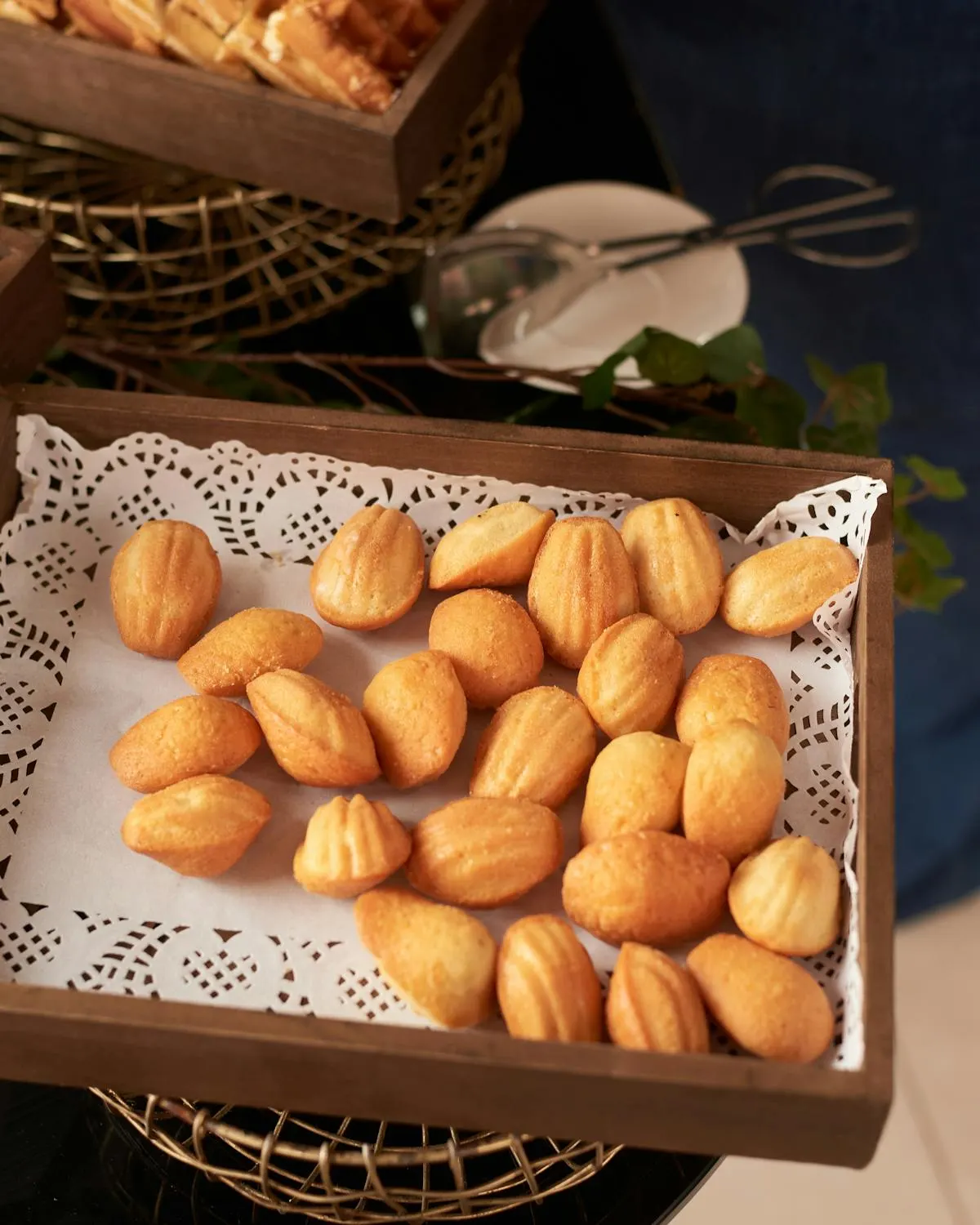
A madeleine is a cake. Not a cookie, whatever the shape suggests. It is a small sponge, baked in a shell-shaped mold, with a hump on its back and a crisp, ridged face on its front, and it has a shorter life than almost anything else that comes out of a French kitchen.
That last part is the whole story of the madeleine, and it is why they are the specialty of this house rather than one item among many.
Where it comes from
The madeleine belongs to Commercy, a town in Lorraine in the northeast of France. The stories about who first baked one and for whom do not agree with each other, and none of them can be checked, so I will leave them alone. What is certain is that by the nineteenth century Commercy was known for them, and that the shell mold, the batter, and the name have not changed much since.
Marcel Proust made it famous in a different way. A madeleine dipped in tea, in the first volume of his novel, is what sets off the memory that runs for the rest of the book. Most people who quote the passage have not read the book. That’s fine. He was right about the cake.
The batter
The batter is close to a génoise. Eggs and sugar are whisked until pale and thick, the flour is folded in, and then melted butter goes through it last. Some kitchens brown the butter first, which gives the cake a nutty depth. Honey often goes in alongside the sugar, and it does two jobs: it adds flavor, and it keeps the crumb moist for a few hours longer than sugar alone would.
Ours use Beurre d’Isigny AOP, farm eggs, blossom honey, and a little orange zest in the traditional version. Those four things are the reference. Everything else on the madeleine list is a variation on them.
Then the batter rests. This is the step that people skip at home and then wonder why their madeleines came out flat.
The hump
Turn a good madeleine over and there is a dome on the back, sometimes a dramatic one. In French it is la bosse. It isn’t decoration and it isn’t luck. It is the signature of a batter that was rested cold and then put into a hot oven.
Here is what happens. Cold batter goes into a hot mold. The outside of each cake sets almost immediately, while the center is still cold and still rising. With the edges fixed, the only direction the middle can go is up, so it pushes through the top in a dome. The sharper the contrast between the cold batter and the hot oven, the taller the hump.
Batter that was not rested, or an oven that was not hot enough, gives you a cake with a flat back. It will taste fine. It won’t be a madeleine in the way that the ones from Commercy are madeleines.
The two faces
A madeleine has a shell side and a hump side, and they are different cakes.
The shell side is the one that touched the mold. It is smooth, ridged, and golden, and the edges are the crispest part of the whole thing. The hump side is soft, pale, and tender. Eating one means getting both in the same bite, the crisp edge and the soft dome, and that contrast is what a fresh madeleine has that an old one does not.
The clock
This is where the madeleine differs from almost everything else in the case.
Those crisp edges start to soften within hours of baking. The dome stays soft for a day. After that, the cake begins to dry from the outside in, and the thing that made it worth eating is gone. A madeleine two days old is a perfectly acceptable small sponge cake. It isn’t the same product.
So we bake them the morning they go out, never the day before, and the honest answer to how long they keep is: within 24 hours of baking. Keep them in their box at room temperature. Do not put them in the refrigerator. The cold dries a sponge crumb faster than the counter does, and a chilled madeleine is a sad, dense thing.
If a few are left the next morning, a short warm-through in a low oven brings the edge back for a few minutes. That’s a rescue, not a plan. The plan is to eat them the day they arrive.
Why we lead with them
A bakery with a counter can bake madeleines through the day and sell them as they cool. We don’t have a counter. Everything here is baked to order and delivered, which means the timing problem is ours to solve, and solving it well is the whole point of specializing in something this perishable.
It also means a madeleine from us has never sat in a case. It was in a mold that morning. That’s the reason the flavor list exists, from the lime and thyme to the salted caramel center, and the reason a box of them makes a better gift than something that keeps for a week: the person opening it is getting the cake at the only moment it is fully itself.
Where they belong
Madeleines suit the morning. A box on a conference table with the coffee, a tray in an office kitchen, a client gift that arrives the day it was baked. They suit a wedding in a particular way too: at a live station, a tray can come out of the oven during the reception itself, which is a thing very few desserts can do.
They do not suit arriving on Monday for a Thursday meeting. If you want them for a specific morning, that is the date to give us, and we will bake to it.
Get in touch with the date and the count, and tell us which of the flavors you want in the box.