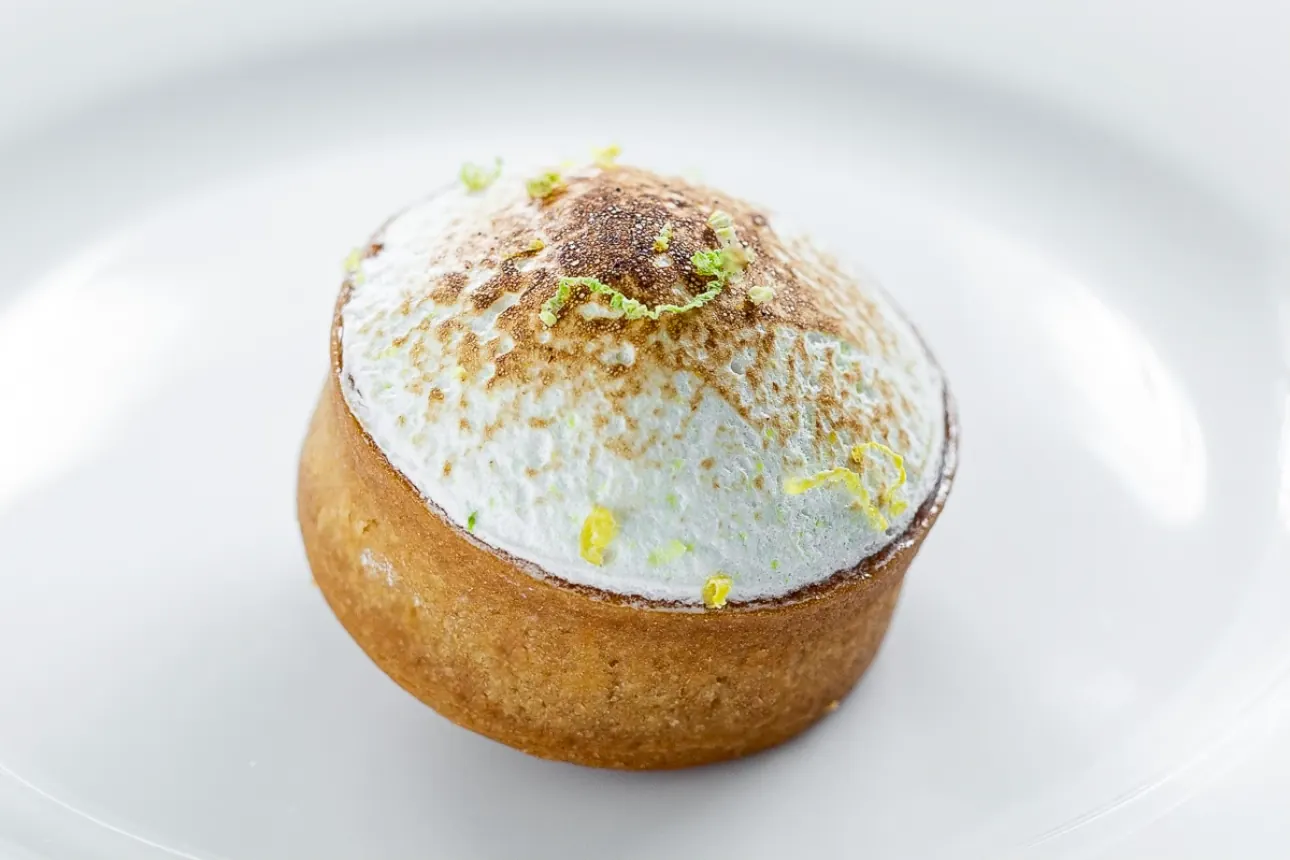
Somebody asked last week why the meringue on the lemon tart does not go grayish and slump the way the one on a grocery-store lemon pie does by dinner. Fair question. The answer is that they are not the same thing. They are not even made the same way.
French pâtisserie names three meringues, and a French kitchen uses all three. Française, suisse, italienne. Same two ingredients every time, egg white and sugar, and three different results depending on when the heat arrives. The names describe the method, not a rivalry, and every one of them is standard French technique.
The three, and what each is for
Meringue française is the one most people have made at home. Raw whites, sugar beaten in cold, whipped to peaks. Nothing has been cooked yet, so it is made to go into an oven: it is what becomes a baked meringue shell, a vacherin, the shells of a macaron. Uncooked and left sitting, it will let go of its sugar within a few hours, which is exactly why the recipe sends it straight to the heat.
Meringue suisse warms the whites and sugar together over a bain-marie until the sugar dissolves, then whips. Denser and glossier, and stable enough to sit. It is the base of a Swiss buttercream and the one for piped shapes that get dried rather than browned.
Meringue italienne is the one on the tart, and it is the traditional finish for a tarte au citron meringuée. The sugar goes into a pan with water and cooks to firm-ball stage, about 245°F, and then that syrup is poured in a thin steady stream into whites that are already whipping. The whites cook on contact. By the time the bowl comes back to room temperature the meringue is already a finished, cooked thing.
Why the difference shows up on a plate
A cooked meringue holds. It does not weep, it does not shrink back off the edge of the shell overnight, and it takes a torch without collapsing, which is why the top of the tart can be browned in patches and stay exactly where it was put.
It is also the reason the meringue can be piped into a dome and still be a dome the next day, and the reason it can be browned with a torch at the last moment instead of baked.
There is a fussier reason a small kitchen reaches for it. A meringue italienne is forgiving about sitting. A batch can be made, used on one thing, and the rest still be good half an hour later. In a kitchen where the tarts are finished to order rather than built at six in the morning and left under a light, that matters more than it sounds.
The part underneath
The meringue is the visible half. Under it is lemon curd, and under the curd a sablé shell that was baked on its own before anything wet went near it, which is the whole argument for a sablé in the first place. A shell baked blind and cooled properly stays crisp under curd for a day. A shell baked with the filling already in it does not.
Cut the tart and you can see the order of operations: the shell wall standing up on its own, a clean band of curd that holds its line rather than running, and the meringue sitting on top of it without sinking in.
The zest on top is lemon and lime together. Lemon alone in a curd this sweet flattens out. Lime brings the edge back, and a small amount of both grated over the meringue at the end means you get the smell before the first bite, which is most of the point of zest.
Ordering one
The Tarte au Citron Meringuée is on the menu at the same price as the other tartelettes. Tartelettes hold for two days refrigerated, and the meringue is the part that makes that possible rather than the part that limits it. Take it out of the fridge twenty minutes or so before eating.
For a table rather than a person, the tartelettes are what the dessert-table builds are assembled from, and a tray of these next to the pine-nut tarts covers the two ends of the sweet range, sharp and nutty, without anything in between that needs explaining.